
Key Takeaways
- The Mind of the Creator: In Sanskrit, Manas translates to mind and Sarovar to lake. The lake symbolizes the original purity of consciousness before mental agitation begins.
- The Union of Shiva and Shakti: Kailash represents unmoving masculine presence, while Mansarovar embodies luminous feminine grace, creating an elemental balance of stillness and flow.
- Light Beside Shadow: The neighboring presence of Lake Rakshastal illustrates the psychological coexistence of serene clarity and turbulent subconscious desires.
- Essential Pilgrimage Purification: Traditionally, sitting beside the waters precedes the circumambulation of Mount Kailash, allowing seekers to quiet mental turbulence before facing the mountain.
The Mirror at the Roof of the World
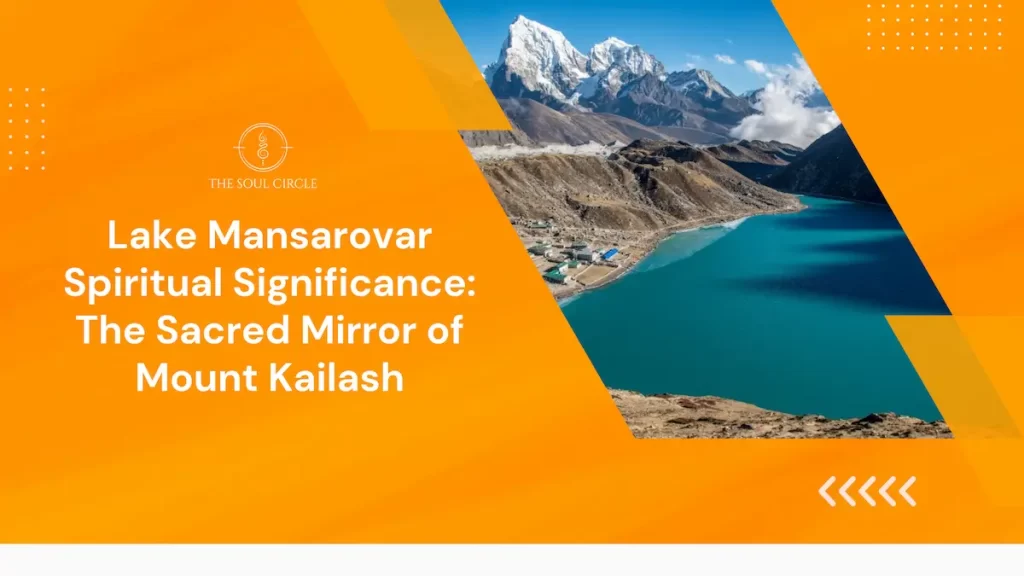
High on the arid plateau of Western Tibet, resting at an elevation of 4,590 meters above sea level, lies an expanse of water so pristine that it defies ordinary description. Under an immense Himalayan sky, the surface shifts through shades of aquamarine, deep turquoise, and radiant emerald.
For centuries, seekers navigating this harsh Trans-Himalayan landscape have recognized that the true Lake Mansarovar spiritual significance extends far beyond scenic alpine beauty.
When you stand beside its shores, the sheer quietude of the environment exerts an immediate pull on the nervous system. The rapid mental calculations, operational deadlines, and persistent noise that define modern executive life seem to dissolve against the horizon. The water does not demand anything from the traveler; it simply reflects the sky, the surrounding snowfields of Gurla Mandhata, and the southern silhouette of Mount Kailash.
To understand why thousands of pilgrims journey across continents to reach this remote altitude, one must look into the ancient philosophical roots that bind these waters to the evolution of human awareness.
Decoding the Origin: The Lake Mansarovar Spiritual Significance in Ancient Texts
To comprehend the Lake Mansarovar’s spiritual significance, we must first examine the etymology of its Sanskrit name. The word is composed of two roots: Manas, meaning cosmic mind or intellect, and Sarovar, signifying a sacred lake or vast body of water.
In Sanatana Dharma, classical texts recount that Lord Brahma, the cosmic architect of creation, conceptualized the lake in his mind before manifesting it into the physical realm. Brahma sought a pristine sanctuary where enlightened beings could perform contemplative austerities without external distraction. Because the lake was born from thought before it existed as water, it represents the primordial intellect in its unclouded, untainted state.
Historical documentation preserved by UNESCO World Heritage Centre recognizes the Kailash Sacred Landscape, including Lake Mansarovar, as one of the most culturally revered sacred geographies in the world.
The lake is also intimately woven into the epic narratives of the Ramayana and Mahabharata. According to tradition, the sage Vishvamitra described how the holy Sarayu River, which nourishes the kingdom of Ayodhya, originally sprang from the mental reservoir of Mansarovar.
Studying Mansarovar and Kailash history reveals that these landscapes were never treated merely as physical landmarks. They were revered as living metaphysical maps where external geography mirrors internal human faculties.
The Alchemy of Shiva and Shakti: Kailash and Mansarovar
In Eastern spiritual psychology, Mount Kailash and Lake Mansarovar cannot be understood in isolation. They function as a profound energetic polarity, illustrating the eternal dance between stillness and movement, form and formlessness.
Mount Kailash stands as the archetype of Purusha, the unmoving, masculine presence associated with Lord Shiva. It is vertical, stark, silent, and immovable. It represents pure, witness consciousness that remains untouched by the passage of time.
Lake Mansarovar embodies Prakriti, the dynamic, feminine creative energy known as Shakti. It is horizontal, receptive, luminous, and fluid. While Kailash represents the silent observer, Mansarovar represents the vibrant consciousness that animates existence.
When we examine this sacred pairing, the Lake Mansarovar’s spiritual significance emerges as the receptive ground of awareness in which reality is perceived.
Without stillness, movement becomes chaotic. Without fluid expression, stillness remains unexpressed. The pilgrim who approaches the lake begins to understand that spiritual maturity does not mean rejecting worldly activity; it means anchoring dynamic action in unshakeable presence.
Light and Shadow: The Mystery of Mansarovar and Rakshastal
Just a short distance westward across an isthmus lies another massive body of water: Lake Rakshastal. The contrast between these adjacent lakes forms one of the most profound psychological allegories in sacred geography.
Lake Mansarovar is circular in form, mirroring the sun, full moon, and the mandala of wholeness. Its waters are sweet, fresh, and supportive of life. Even during intense Himalayan winds, its shores retain a calm, radiant quality.
In contrast, Lake Rakshastal is crescent-shaped, characterized by dark, saline water, lacking aquatic life, and frequently lashed by turbulent, cold winds. In local folklore, Rakshastal is the lake of the demons, associated with Ravana, the brilliant yet ego-bound king who performed severe austerities to acquire supernatural power for personal conquest.
This natural coexistence deepens the Lake Mansarovar’s spiritual significance by illustrating the dual nature of the human psyche:
- Mansarovar represents conscious presence: It is the space of clarity, self-knowledge, compassion, and surrender.
- Rakshastal represents unexamined ambition: It reflects the restless, grasping ego driven by fear, control, and endless accumulation.
Significantly, the two lakes are connected by an intermittent natural channel called the Ganga Chhu. In conscious inquiry, Rakshastal is not evil; it represents vitality and drive when unguided by wisdom.
The journey from Rakshastal to Mansarovar symbolizes the conscious transition from ego-driven striving to grounded awareness. It reminds high achievers that ambition without self-awareness inevitably becomes bitter, while effort rooted in presence yields deep nourishment.
The Sacred Waters Across Ancient Traditions
The spiritual pull of these waters spans four major Asian traditions: Hinduism, Buddhism, Jainism, and the indigenous Bon tradition of Tibet.
Geographical research published in Encyclopaedia Britannica notes that Lake Mansarovar serves as the hydrological cradle for four of Asia’s most essential rivers: the Indus, the Brahmaputra, the Karnali (a major tributary of the Ganges), and the Sutlej. This physical life-giving role mirrors its spiritual reputation as a source of universal sustenance.
In Buddhism, the lake is known as Tso Mapam, the “Unconquered Turquoise Lake.” Buddhist literature identifies Mansarovar with the legendary Lake Anavatapta, where Queen Maya was carried by divine beings to bathe in pristine waters prior to conceiving Gautama Buddha. The sacred waters Mansarovar contains are thus revered as an instrument of pure conception and spiritual awakening. It is also celebrated as the domain of Guru Padmasambhava, who meditated on its shores to anchor tantric wisdom across Tibet.
In Jain cosmology, the lake is linked to Rishabhadeva, the first Tirthankara, who achieved liberation on the slopes of Mount Ashtapada adjacent to Kailash. Jain pilgrims revere these shores as an environment charged with the energy of complete non-violence and detachment.
For followers of the Bon tradition, the lake is sacred to the goddess Zhangzhung, representing the elemental water spirit that sustains all existence on the Tibetan plateau.
Across diverse traditions, the Lake Mansarovar spiritual significance resonates with a shared insight: before one can climb toward the heights of truth, the mind must first become still enough to reflect that truth clearly.
Preparing the Pilgrim: Why Mansarovar Precedes the Mountain
In classical pilgrimage practice, travelers do not proceed directly to circumambulate Mount Kailash. They spend unhurried days resting, walking, and meditating on the shores of Mansarovar.
There is practical and spiritual wisdom in this sequence. At nearly 4,600 meters, the human body requires gradual physiological adaptation to thin air. However, the somatic settling is equally critical.
When busy professionals embark on a Kailash Mansarovar tour 2026, they carry the momentum of their executive responsibilities with them. The intellect continues organizing schedules, checking notifications, and calculating outcomes.
Resting beside the lake interrupts this mental momentum. Sitting quietly by the water, listening to the gentle lap of the waves against gravel, the internal volume drops.
Experiencing the Lake Mansarovar spiritual significance prior to the Parikrama allows pilgrims to lay down psychological baggage before beginning the grueling 52-kilometer circuit. To understand how this physical terrain mirrors internal conditioning, read our reflection on why Mount Kailash is a sacred mirror.
When the mind is emptied of its noise, the trek around the sacred mountain ceases to be an endurance exercise and becomes a transformative awakening.
Moving Beyond Sightseeing into Sacred Presence
Too often, modern travel converts ancient pilgrimage routes into rapid sightseeing checklists. High-speed vehicles transport tourists quickly across the plateau, pausing briefly for photographs before hurrying to the next camp.
Approaching these lands with conscious awareness demands a completely different posture. It asks you to step out of the consumer mindset and enter the space of the pilgrim.
When you walk slowly along the shoreline of Mansarovar:
- Notice the urge to capture: Observe how quickly the intellect reaches for a camera or smartphone to record the moment instead of experiencing it directly.
- Feel the physical environment: Allow the crisp, dry air, the intense solar radiation, and the cold water to ground your attention in the physical present.
- Observe your mental reflection: Look at your thoughts as you would look at ripples on the lake. Notice that thoughts pass, yet the deeper ground of awareness remains undisturbed.
For seekers seeking to experience this landscape with dedicated guidance, our conscious journeys integrate daily inquiry, group satsang, and contemplative silence. Explore our upcoming retreats and journeys to see how geography can serve as an instrument for profound self-realization.
Frequently Asked Questions About Lake Mansarovar
What is the primary Lake Mansarovar spiritual significance across Eastern traditions?
Across Hinduism, Buddhism, Jainism, and Bon, the Lake Mansarovar spiritual significance represents the purity of the mind (Manas) and the cleansing of past karmic impressions. It is revered as the feminine energetic counterpart to the masculine stillness of Mount Kailash.
What is the key distinction between Mansarovar and Rakshastal?
Mansarovar is a round freshwater lake symbolizing clarity, wisdom, and conscious presence. Rakshastal is an irregular saltwater lake symbolizing unexamined ego desires, restlessness, and shadow tendencies. Their close proximity illustrates the coexistence of light and shadow within human consciousness.
Can pilgrims bathe in the sacred waters Mansarovar provides?
Pilgrims traditionally collect the sacred waters Mansarovar holds for personal blessing and spiritual cleansing. While environmental regulations by local authorities now restrict direct swimming to preserve the lake’s delicate alpine ecology, taking ceremonial sips and washing the face and hands remain common sacred practices.
How does visiting Lake Mansarovar prepare seekers for the Kailash Parikrama?
Spending time at Lake Mansarovar allows the physical body to acclimatize to high altitude while allowing the mental chatter of everyday life to settle. This internal quietness ensures that the physical trek around Mount Kailash is undertaken with genuine reverence rather than performance anxiety.
Returning to the Silence of the Waters
When you leave the high Tibetan plateau and return to the demands of daily life, the landscape does not truly leave you.
The mountains remain where they have stood for millions of years, indifferent to the shifting concerns of human civilization. Yet the lessons learned beside their waters can fundamentally alter how you live, lead, and relate to your own thoughts.
Ultimately, understanding the Lake Mansarovar’s spiritual significance transforms pilgrimage from an outdoor excursion into an inner return. The lake demonstrates that peace is not something you must construct through force. Peace is the natural baseline of your awareness when the agitation of egoic striving is allowed to rest.
By opening yourself to the quiet depth of these sacred shores, you realize that the Lake Mansarovar’s spiritual significance is not confined to Tibet; it lives as the quiet witness within your own being.
Experience the sacred waters and peak of Kailash with a conscious cohort. Explore our sacred journeys with Neeraj Gala today to begin your pilgrimage to the heart of Himalayan stillness.